Documentation
What we measure, and what the words mean.
Enough detail to check our work, argue with our method, or reproduce the parts of it you want to run yourself.
The measurement
Four rules, applied every run.
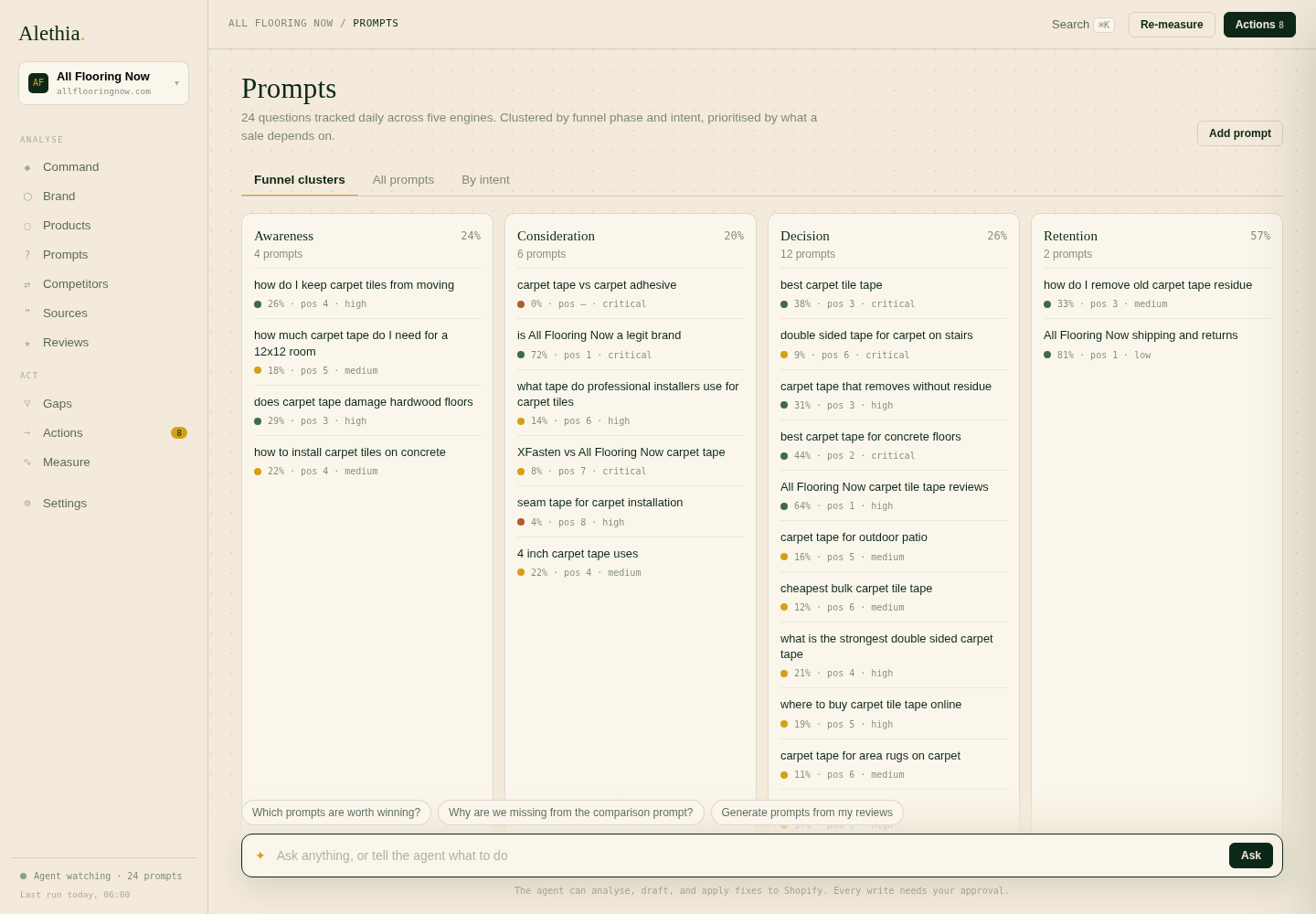
Question set
Buying questions per product, written the way a customer types them and approved by you before anything runs. Your brand name never appears in a scored question.
Two conditions
Every question is asked with retrieval available and without it: whether an assistant can find you, and whether it knows you at all.
Asked several times
A single answer is a sample of one, and these systems are not deterministic.
Untouched products
Comparable products are held untouched, so a change in your treated products can be told apart from a change in the engine.
The numbers
Every metric in a report.
| Metric | Definition | What it tells you |
|---|---|---|
| Mentioned | The product or brand is named anywhere in the answer. | Reach. The weakest of the five: named in passing is not recommended. |
| Recommended | Named as an actual pick rather than in passing. | The headline. This is the one that corresponds to a buying decision. |
| Conversion | Recommended divided by mentioned. | The diagnostic. High mentions with low conversion is a trust problem, not a reach problem. |
| Position | Where you land among the products named. | Matters most in answers that name three to five. |
| Sources cited | Every page the assistant drew on, per answer. | Where the work is. A source cited when you lose and never when you win is an address, not an idea. |
Every rate is reported with a confidence interval, and a product sampled too thinly to rank is listed as such rather than ranked on three mentions.
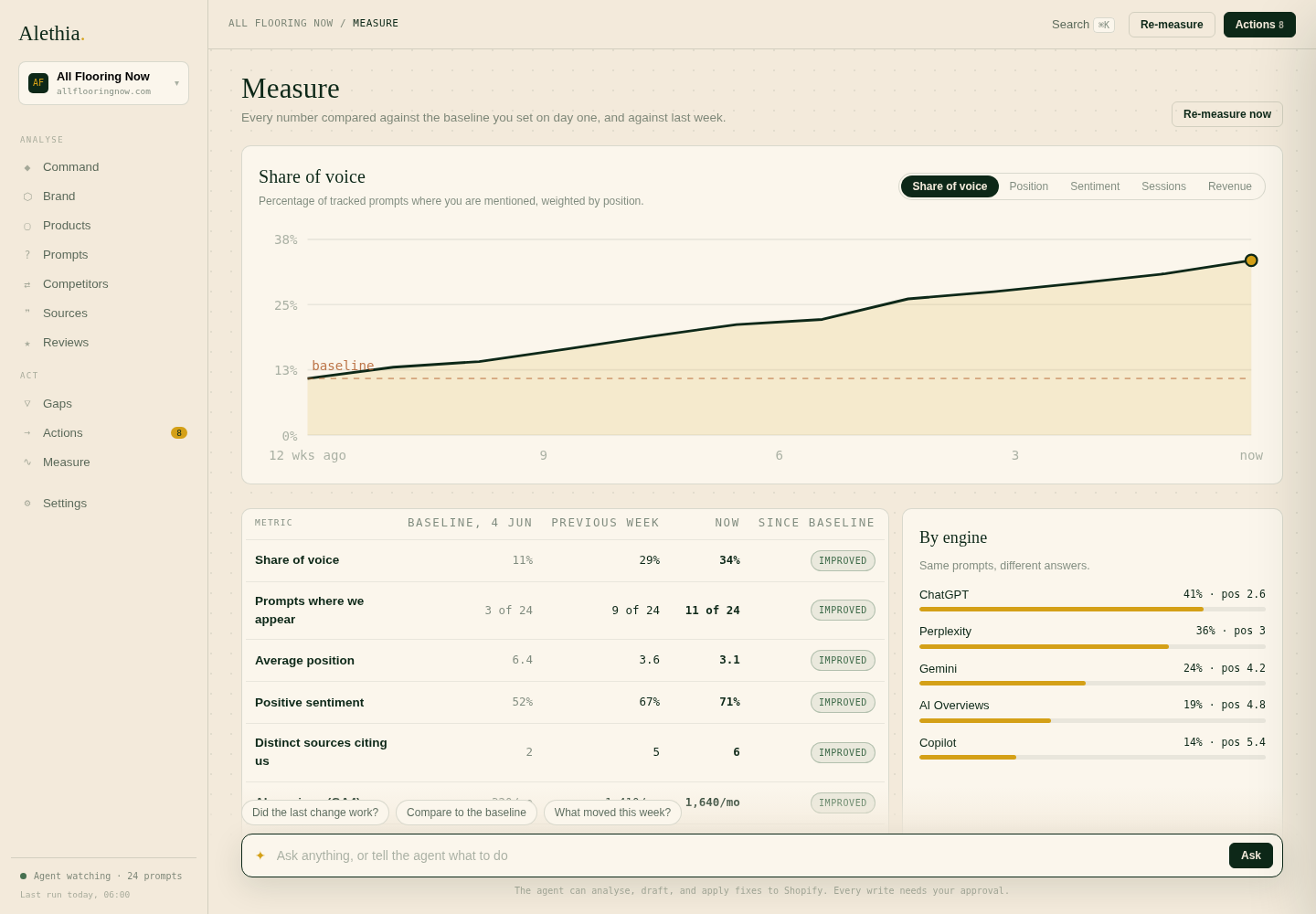
The baseline
Recorded first, then frozen.
The questions, the repeat counts, the scoring and the engine are hashed together. If any of them changes, later results are not compared against it: the comparison is refused rather than reported with a caveat nobody reads.
Reading a report
How to read what we send.
Measured or inferred
Every finding is labelled. An inference names the specific thing it is not safe to claim.
Open questions
What the run could not settle, and how to close each one, so you can tell a checked-and-clear from a never-checked.
Every change graded
Each change carries the metric it should move and the date it is checked, including the ones that did nothing.
What we will not claim.
That we caused a change. What is defensible is narrower: these questions were measured before and after, these changes were published, this set moved and the untouched set did not. Any vendor promising a guaranteed position in an AI answer is describing something nobody controls.
Questions
Questions we are asked.
How many questions do you ask, and who writes them?
Up to 25 buying questions per product depending on plan, written the way a customer types them and approved by you before anything runs. Once a baseline is recorded the set is frozen.
Why do you ask each question more than once?
Because these systems are not deterministic. A single answer is a sample of one, and a rate calculated from it cannot carry a confidence interval worth reporting.
Why do you measure with search on and search off separately?
Search off asks whether the model knows you at all, a multi-year problem. Search on asks whether it can find and trust you, fixable this quarter. A single blended number hides which one you have.
Why not just report one visibility score?
Because a single score names no product, no question and no source, so it cannot tell you what to do.
What happens if the engines change mid-engagement?
The control products catch it. If your treated products and your untouched controls move together, the engine moved and we say so.
No commitment
See how AI is selling your products.
Get your free Alethia AI report and see where your brand stands across the AI platforms your customers are already using.


